
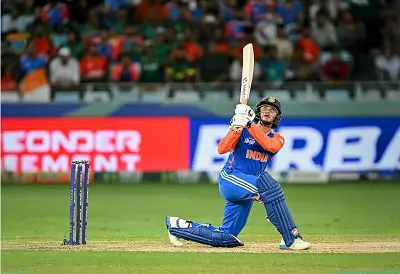
The cricketing world is currently witnessing the rise of a phenomenon. Abhishek Sharma isn’t just a batsman; he’s a statement of intent. Known for his “see ball, hit ball” philosophy, Sharma has redefined the role of a modern T20 opener. However, in the latest clash between India and New Zealand, the Black Caps proved that even the most fearless strikers can be outsmarted with a clinical tactical blueprint.
The Fearless Intent: 7 Times a First-Ball Sixer
Abhishek Sharma’s reputation precedes him. He bats with a level of aggression that makes even seasoned bowlers second-guess their lengths. From the very first ball, he doesn’t look to “settle in”—he looks for the boundary.
Incredibly, stats show that there have been 7 instances where Sharma has dispatched the first ball of his innings for a six. This “no-look-back” approach has made him the most dangerous Powerplay batter in world cricket today. For Abhishek, the game starts at the 5th gear.
The Nagpur Nightmare: Abhishek’s 84-Run Blitz
To understand why New Zealand was so desperate for a plan, we only need to look back at the 1st T20I in Nagpur. Abhishek Sharma was in a mood that can only be described as “destructive.” He hammered 84 runs off just 35 balls, striking at a massive 240.00.
His innings featured 8 towering sixes and 5 fours, leaving the Kiwi bowlers with no place to hide. That knock was the cornerstone of India’s massive 238-run total, a score that effectively batted New Zealand out of the game.
The Strategy: “We Can’t Bowl Him Out, We Must Bait Him”
Following the Nagpur carnage, the New Zealand coaching staff went into overdrive. According to reports and post-match analysis, the plan wasn’t about finding a “magic ball.” They realized that traditional methods—trying to find the edge or bowling tight lines—weren’t working. Sharma’s hand-eye coordination was simply too good.
The strategy shifted: Let him play his shots. The Kiwis decided to use his own aggression against him. They knew he would go for a big hit on the first ball to set the tone, and they decided to give him exactly what he wanted—with a catch.
The Execution: How Jacob Duffy Set the Trap
The 1st ball of an innings is a golden opportunity. The batsman is fresh, yet to gauge the pitch’s bounce or the wind’s effect. Jacob Duffy was handed the ball with a specific instruction: Bowl it in the slot.
The Bait: Duffy delivered a full, tempting delivery right in Sharma’s hitting arc.
The Trap: New Zealand had specifically placed a fielder at the exact location where Sharma’s “first-ball-swing” usually travels.
The Result: Abhishek, true to his nature, didn’t hesitate. He swung hard, but without the full measurement of the Raipur pitch’s pace, the ball didn’t quite clear the rope. It landed straight into the hands of the waiting fielder.
Abhishek Sharma: Out for a Golden Duck. The plan was executed to perfection.
Why First-Ball Wickets Change T20 Games
In T20 cricket, momentum is everything. When a team loses their primary aggressor on the very first delivery, it sends shockwaves through the dugout.
Psychological Edge: The bowling side immediately gains the upper hand.
Strike Rate Pressure: The incoming batsman (Ishan Kishan in this case) is forced to play more cautiously, slowing down the run rate during the crucial Powerplay overs. Data-Driven Captaincy: This wicket is a victory for “Matchups.” It shows that even in a batter-dominated format, smart field placements and psychological baiting can trump raw power.